
[ad_1]
For almost four decades, Yang Zhijun has been fighting for a plot of land.
When she married, in 1982, she decided to stay with her parents in the village where she grew up, Wanfeng, in northern China’s Inner Mongolia Autonomous Region. Her husband had an urban household registration, or hukou, which came with more social security privileges but would have been difficult to obtain. Staying in the countryside would mean living apart from her husband, but, she figured, it would at least allow her to keep a piece of farmland, which by law all rural citizens are entitled to.
But Yang’s fellow villagers had other ideas.
Around that time, China abandoned collective farming in favor of the so-called household responsibility system, where land is collectively owned but divided among families according to their size. Villages have a degree of autonomy, and during assemblies villagers decide together how to parcel up their fields.
Traditional notions that a woman should wed a man outside her own village and move to live with his family meant that fellow Wanfeng villagers considered Yang a freeloader. She had married, but still had the nerve to claim a piece of farmland back home. In 1985, the villagers voted to reclaim Yang’s 2.2 mu as well as the 0.6 mu allocated for her young daughter (about 1,870 square meters combined). Ever since Yang, now 68, has been trying to get it back.
She is far from alone. Wanfeng itself has several such chujianü, or “married-out woman,” who are embroiled in yearslong disputes. The women have argued with village cadres, called on the local chapter of the Women’s Federation to intervene, and relentlessly petitioned government departments high and low.
Lin Lixia is a lawyer at Beijing law firm Qianqian who has advised Yang many times. Since about 18 years ago, she says, there has been a marked, countrywide increase in cases like Yang’s. Since then, the firm, which often represents underprivileged women pro bono, has been approached about more than 3,000 disputes involving rural women fighting for land-use or other rights. They have taken on over 200 such cases, but close to 90% of these lawsuits were either dismissed or decided against the plaintiffs.
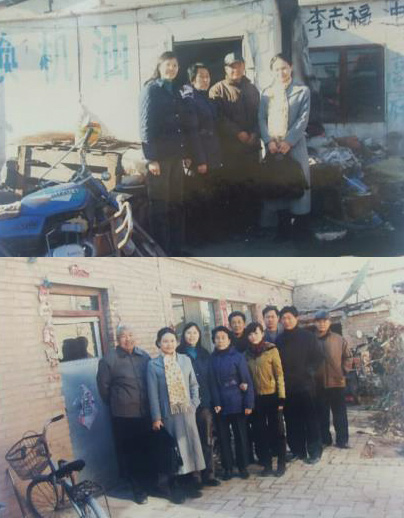
Lawyer Lin Lixia (top photo, left) on a visit to Yang Zhijun’s family. Courtesy of Lin Lixia
And even when a court or a higher-level government department agrees a village was in the wrong, the law is so unclear about how such cases should be handled that women rarely get what they believe they are owed. The end result is usually that the decision is kicked back to the village, as they are, in theory, an autonomous entity in China’s political system. But they will rarely stray from their original decision.
The stakes can involve more than just farming plots. Lin Qun lives in a coastal village in the southern Guangdong province. When she married in 1992, she received the village collective’s blessing to allow her husband’s registration to transfer from his village to hers, and in the following years for their two newborn children to be added too. In 2003, a demolition project landed the village a settlement windfall, and the villagers agreed to put that money into a collectively owned business that would pay everyone a monthly dividend of a little over 1,000 yuan ($121 at the time). But because Lin, who requested the use of a pseudonym, was a chujianü, her fellow villagers decided to exclude her from this benefit.
Lin says that, at the time, she had little understanding of the law; although upset, she figured she’d just have to suck it up. It was only in 2011 that a pamphlet issued by the township government, entitled Safeguarding the Rights of Married-Out Women, confirmed her suspicion that she had been wronged, and galvanized her into fighting for her rights.
Village rules
“Is being born a woman a sin?” In a written statement Ren Xueping prepared for officials about her situation, this sentence is in boldface.
She lives in Quantang Village, which falls under the jurisdiction of Dongyang City in the coastal Zhejiang province. Because her younger brother, her parents’ only son, decided to leave the village for a city life, her parents wanted her to marry a man who would agree to move in with them, so they would have someone to take care of them in their old age. However, in 2015, two years after Ren’s wedding with such a “live-in son-in-law,” her brother changed his mind and moved back home with his girlfriend. Their family home couldn’t house them all, and Ren’s parents began urging her to move out. One relative put it bluntly: “Once you marry, parents are just relatives. And you are a guest in the house. If your brother and his girlfriend want to move in, then you have to leave.”
When Ren went to the village committee to register as a separate household and apply for a residential plot, she remembers being told that “only men were eligible, and women can forget about it.” On her way home, she passed a wall-painted slogan from the one-child policy era urging people not to abort girls: “Sons and daughters are equally valuable — daughters also carry on the family line!” She felt it was deeply ironic.
Quantang’s party secretary once publicly stated: “Giving Ren Xueping land is simply not going to happen. We don’t care about the Law on the Protection of Women’s Rights and Interests; our village rules are not governed by the law. We’re not singling her out — if we give the green light for any woman to come ask for land, what kind of mess would we end up in?”
Village rules are the basis of a village’s autonomy, and commonly include resource and benefit allocation plans as well as decisions made at village assemblies. Lin Lixia explained that, at these assemblies, majority rules. Chujianü are viewed as a minority attempting to carve up the interests of the collective, and are at a disadvantage. In the cases she has come across, village rules often exclude divorced or remarried women, their children, as well as live-in sons-in-law from resource allocation arrangements.
Ren attempted to bypass the village by seeking assistance from the state-run Women’s Federation and higher levels of government, but was still told that she didn’t meet the conditions for applying. According to the land management stipulations of Dongyang City, adult sons can register independent households and apply for a 100-square-meter residential plot. In families with no sons, only one daughter was permitted to apply.
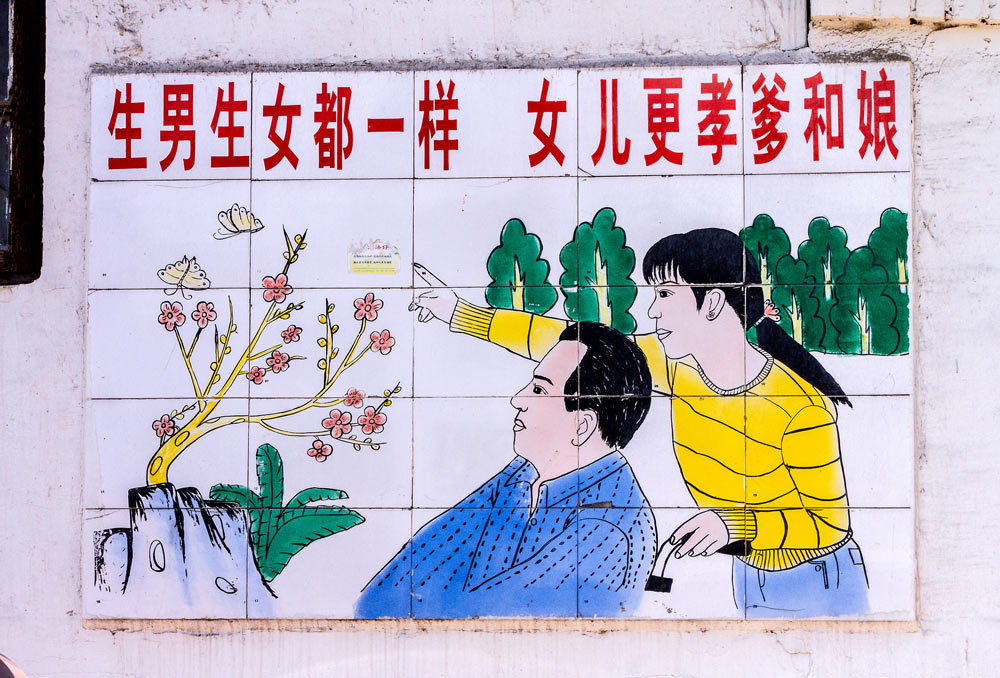
A poster promoting family planning in Zoucheng, Shandong province, 2014. The slogan reads “Sons and daughters are equally valuable — daughters are more filial to their parents.” VCG
More than 2,300 kilometers away, Yang has been facing similar rejections in Inner Mongolia. Going back to 1984, Linhe, the county-turned-district that administers her village, has stipulated that, “Young women from rural households who marry out of here will take their hukou with them … For a family with no sons, the daughter’s husband may choose to join the household and take on caring for the in-laws, but only one such case is allowed in each household.”
Although land rights for chujianü were not really mentioned, the village nonetheless used this stipulation as grounds for repossessing Yang and her daughter’s land. Finding it unacceptable at the time, she went up to the township government to complain. She recalls that the official slammed his desk and yelled: “Nobody forced you to hang around your parents’ place after getting married. Why didn’t you just transfer your hukou out?”
Dead ends
Following legal advice, Ren in 2016 applied for a legality review of Dongyang’s Regulations for Land Management.
First, the Dongyang City Office of Legislative Affairs replied that “no elements of the regulations contravene the law.” She then appealed to the Zhejiang Provincial Office of Legislative Affairs, who refused to hear her case and instead turned her to their counterpart in Jinhua, the city under whose jurisdiction Dongyang falls. Eventually, thanks in part to the intervention of the Women’s Federation, the Jinhua municipal government demanded that Dongyang change its regulations.
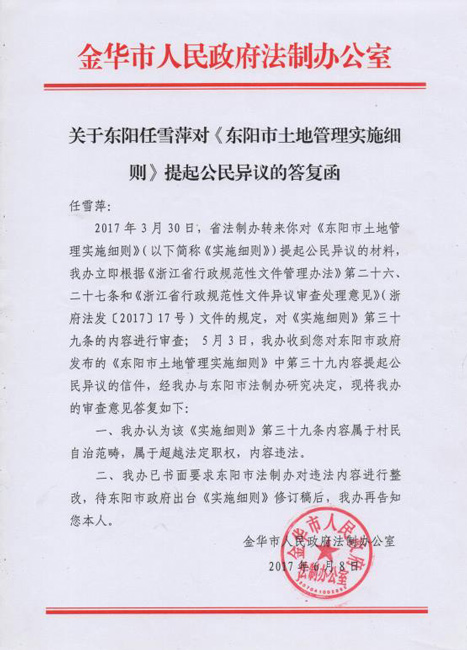
The Jinhua municipal government’s official reply to Ren Xueping. Courtesy of Ren Xueping
“At that moment, I was confident,” Ren says. “But, as it turned out, I had gotten ahead of myself.” Dongyang did not clear up the ambiguity. It merely removed the phrase, “In families with no sons, only one daughter was permitted to apply,” before handing Ren’s case back to the village collective. So, after a long journey being sent from one office to another, she found herself back at square one: with the committee of the village collective. Unsurprisingly, their answer was still a categorical no.
Ren then launched a civil suit against the collective. In 2018, the court dismissed the case and reiterated the autonomous governance of the village. It is considered unacceptable for a brother to marry while his married sister is still living at home. But Ren’s brother was getting close to thirty, which in rural China is considered the age by which one must get married. Ren relented. She and her husband rent the cheapest old house in the next village over, and make ends meet by doing all manner of odd jobs.
Yang’s legal efforts fared similarly. She began petitioning higher authorities. In May 2009, on her way to visit the central government in Beijing, Yang was intercepted by police from Linhe and sent back to the Linhe Mediation Center, a government-run institution meant to alleviate courts’ caseloads. In distress and anger, she didn’t eat for three days. Finally, a cadre handling petition affairs reached out: “It’s unlikely that the land will ever be reallocated. Could there be a workaround, by compensating for the expropriated land?”
According to the agreement they subsequently reached, several married-out women, including Yang, would be compensated by the township — a possible sign that even other officials figured the village would never soften its stance. Not long after the agreement was signed, she received the first payment: 54,000 yuan ($8,000). The rest was paid up over a two-year period, totalling 250,000 yuan.
But Yang’s fight was far from over. Her children, who are now in their thirties, are still without any land (or financial compensation). Since the agreement, she brought this issue to the court several times. Eventually, the government of Bayannur, the city that administers Wanfeng Village, confirmed that Yang’s children are legitimate members of the collective. It then delegated the responsibility to act down the hierarchy. It tasked the district government with pushing the township government to call a village assembly, so that unclaimed plots of land could be identified and allocated to them.
That was in 2019. To this day, the village has not budged. Every time Yang and the other women go through this cycle, the same orders are given down to the village, which holds an assembly, and doesn’t change its stance.
Pariahs in their own village
Not only are their problems unsolved, the women have become outcasts. Every time the issue comes up at the assembly, people physically distance themselves from Yang — even point at her and say things like, “You went and got married, and now have the gall to ask for land back?” or “When people like you get to have land, I’ll start writing my surname upside down” — an expression similar to “When hell freezes over.”
The women would save up to dole out gifts like cigarettes and fruit, in the hope of banking some goodwill come voting time. Villagers would take them in a heartbeat, and turn their backs in another. “As they see it, marrying out a daughter is like tossing out a basin of water,” Yang says. “We don’t deserve anything anymore.”
Other than for elections, Lin Qun’s family is never invited to village assemblies. Even for meetings that would be specifically about them, the village committee never calls ahead. When, in 2003, the entire village was relocated, the apartments people would receive in compensation were determined by drawing lots — but, because nobody wanted to be neighbors with them, the households of the married-out women were singled out and clustered together. Even the garbage collection arrangements excluded them.
Villagers say Lin “married a useless husband, so now [she’s] digging for whatever assets she can get her hands on.” After her court battles failed, some would rub her nose in it, “The judge ruled against you, no official supports you. Do you still have the gall?”
Lin feels trapped. When it comes to doing her collective duty as a villager, such as putting out mountainside fires, replanting trees, or making donations to fix bridges and roads, the village doesn’t consider them outsiders — “but when they allocate benefits, we’re suddenly seen as freeloaders,” Lin says.
And the benefits do not stop with the monthly 1,000 yuan in dividends; there’s also a subsidy of around 5,000 yuan each Spring Festival that eludes her. So every year, she misses out on well over 15,000 yuan in total. Even today, at 61, she still has trouble making ends meet, commuting by motorbike with her husband to do odd jobs out of town.
Yang Zhijun’s husband was diagnosed with hypertension and heart disease way back in his forties, and has already undergone three expensive angioplasties. There’s hardly any stable household income to speak of; they’ve had to rely mostly on support from their siblings. Most of the compensation she received has been spent on treating her husband.
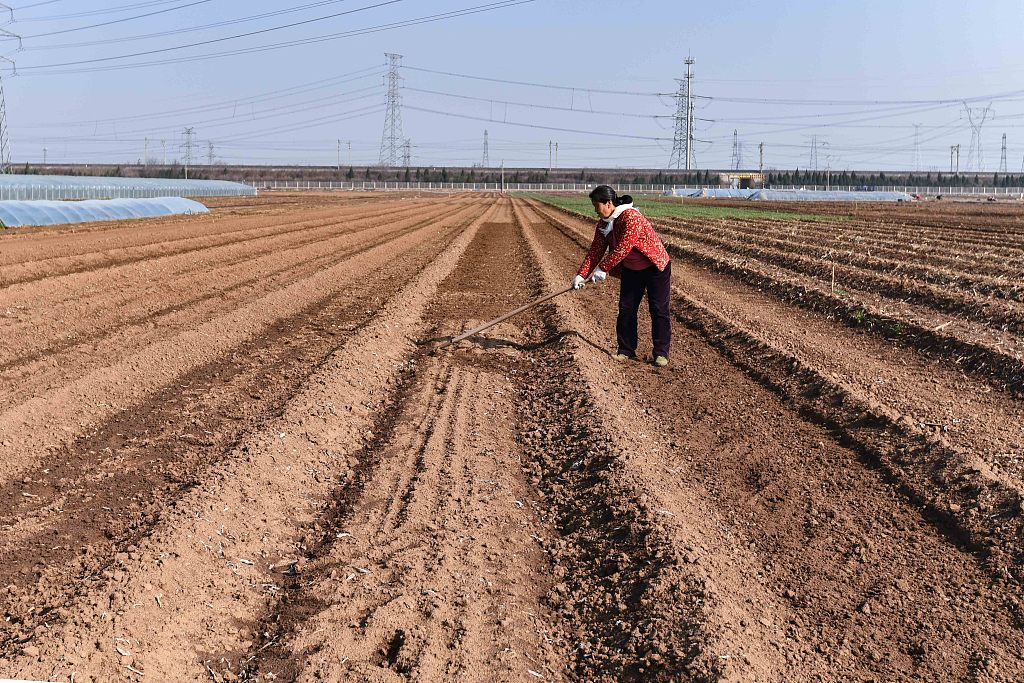
A woman works in a field in Qingzhou, Shandong province, March 4, 2021. VCG
A matter of time
Lin Lixia argues that, even if current laws are insufficient, courts still have plenty of legal grounds to support women should they so choose. For example, the Law on the Protection of Women’s Rights and Interests specifically stipulates that married-out women enjoy equal rights to contracted farmland, collective dividends, and residential plots. The Law on Land Contract in Rural Areas also specifies that, if women have not received a new plot of land from their new place of residence, the land that was contracted to them in their previous place of residence cannot be expropriated.
Even under the current way of doing things, where cases are constantly handed back to villages to be ruled on autonomously, change might be on the way.
The old village rules of Chengguan, a rural residential community in Huaning County, in the southwestern Yunnan province, stipulated that when a woman gets married, her hukou follows her to her husband’s residence; if the registration was not moved out in three months’ time, the village reserved the power to exclude her from any future allocation of benefits; and households with sons may not invite sons-in-law to move in, whereas those without sons may invite one at most.
In special cases, the old rules said, individuals may pay a one-off “right to enjoy fixed assets fee” of 50,000 yuan in order to transfer their hukou to Chengguan. He Yonghui, the community’s party secretary, says that conflicts surrounding the rights of married-out women have been a thorn in his side ever since he took office in 2013. The most serious incident occurred in 2015, when a legislative session in the county seat was interrupted by the brother of a chujianü suddenly bursting into the venue, snatching the microphone from the speaker, and decrying the unfair treatment his sister had been subjected to.
Since then, He decided to reform the rules. Initially, even the female cadres disagreed with him, citing that the existing conventions had been in place for decades and shouldn’t be changed on a whim. As he sought opinion on a greater scale, the voices of opposition multiplied. At public consultations, people would go ballistic arguing with him.
One time, someone blocked his path and confronted him: “Why are you so intent on taking our collective’s property and giving it to outsiders? When all our property has been split up, will you be happy then?” Every time, he would calmly offer his stock explanations: “Gender equality will be a reality sooner or later. If we don’t change things today, it’s just going to happen tomorrow anyway.” “Who can say for sure if their child will be a boy or a girl? All households stand to gain from equality.”
After more than 40 village assemblies, the new rules were finally passed in 2019. Husbands, wives, and their children can independently determine whether to move their hukou and places of residence or not. Registered members of a given household, including married-out women, sons-in-law, and their children, are all recognized as members of the village collective.
In the past two years, the land rights issues of rural women have received attention at the national Two Sessions, China’s annual legislative and consultative meetings. The law on rural economic collectives is currently being drafted. Ren is looking forward to any legislative changes. Having fought so long, she has become something of an expert on the issue, “The same way a patient suffering from a chronic illness becomes an expert on their condition,” she says.
Yang’s family situation has recently, finally, somewhat improved. In 2019, collective land was expropriated, and Yang was paid the same 10,000-yuan compensation that other villagers received. But what hasn’t changed is how people treat her. There are still villagers who say that she’s disgraceful and unscrupulous — that she kicks up all the fuss out of desperation brought by poverty. She’s used to these remarks now, and will not be discouraged from fighting for what she believes is rightfully her children’s. It’s a matter of equality, and, in a way, it’s become second nature after doing it for decades.
Reporter: Guo Huimin.
A version of this article originally appeared in Beijing Youth Daily. It has been translated and edited for brevity and clarity, and published with permission.
Translator: Lewis Wright; editors: Zhi Yu and Kevin Schoenmakers.
(Header image: Women transplant rice seedlings in Huai’an, Jiangsu province, June 24, 2018. VCG)
[ad_2]
Source link
