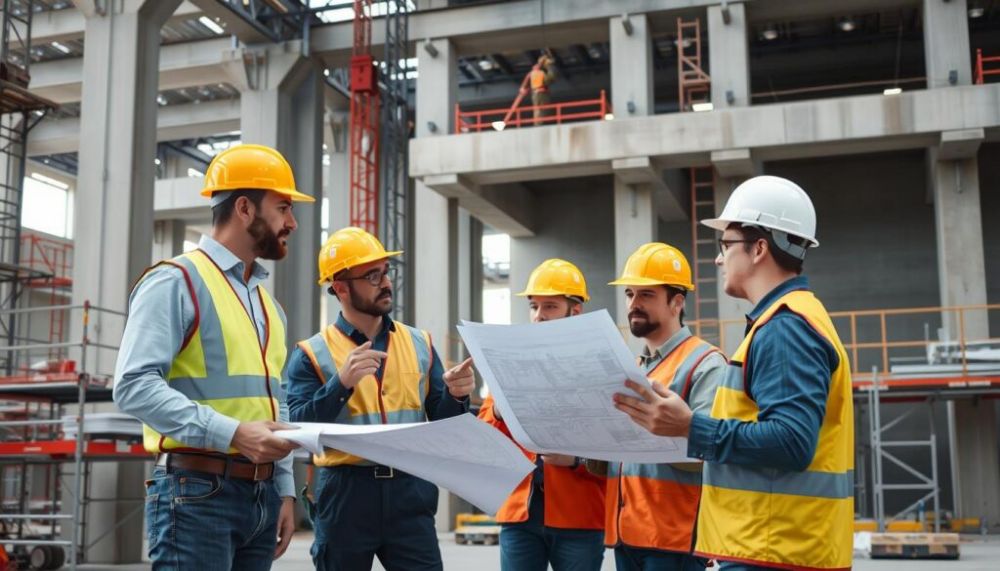
Industrial Construction Services That Power Global Infrastructure, modern civilization depends on vast networks of infrastructure that support energy, manufacturing, logistics, and heavy industry. At the core of this global framework lies Industrial Construction Services, a specialized domain that transforms complex engineering concepts into functional, large scale facilities. These services are responsible for building the physical backbone of economies, from power plants and refineries to manufacturing hubs and transportation terminals. Each project represents a convergence of technical precision, logistical mastery, and strategic planning.

The nature of Industrial Construction Services demands a deep understanding of high capacity systems and operational environments. Unlike conventional building projects, industrial developments must accommodate extreme loads, hazardous materials, and continuous operational cycles. Engineers and planners work in tandem to ensure that every component is optimized for durability and efficiency. Site selection alone involves extensive geological and environmental analysis, ensuring that the infrastructure can withstand long term industrial stress. This foundational phase sets the tone for everything that follows, establishing a framework where safety, scalability, and performance are non negotiable priorities.
Engineering Complexity and Structural Precision
Industrial facilities are among the most complex structures ever built, requiring advanced engineering techniques and meticulous coordination. In Industrial Construction Services, structural design is driven by functionality rather than aesthetics, focusing on load distribution, vibration control, and operational flow. Factories, processing plants, and energy facilities must be engineered to support continuous heavy duty operations without compromising safety or efficiency. This requires a deep integration of mechanical, civil, and electrical engineering disciplines working in harmony.
Precision is critical at every stage of construction. Even minor deviations in alignment or material quality can have significant operational consequences. Advanced modeling systems are used to simulate structural behavior under various conditions, allowing engineers to predict performance before construction begins. Industrial Construction Services rely heavily on these digital tools to reduce risk and improve accuracy. Materials such as reinforced steel, industrial grade concrete, and corrosion resistant alloys are selected based on rigorous performance criteria. The result is a built environment capable of enduring extreme mechanical stress while maintaining operational integrity over decades.
Global Supply Chains and Logistical Coordination
One of the defining features of large scale industrial development is the complexity of its supply chain network. Materials, machinery, and specialized components often originate from multiple regions across the world. Coordinating these resources requires precise logistical planning and real time communication systems. Industrial Construction Services play a crucial role in synchronizing these global supply chains to ensure that every element arrives at the right place and time.
Transportation logistics must account for weight, size, and regulatory constraints associated with industrial equipment. Oversized machinery such as turbines, reactors, and heavy fabrication units require specialized handling and transport infrastructure. Delays in any part of the supply chain can significantly impact project timelines and costs. To mitigate these risks, construction teams employ advanced tracking systems and predictive scheduling models. This level of coordination ensures that global infrastructure projects maintain momentum even when operating across multiple jurisdictions and regulatory environments. The efficiency of these systems reflects the maturity and sophistication of modern industrial development practices.
Safety Systems and Operational Risk Management
Safety is a central pillar in industrial development due to the scale and complexity of operations involved. Industrial facilities often handle high pressure systems, volatile substances, and continuous mechanical processes. Within Industrial Construction Services, safety engineering is integrated into every phase of design and execution. Risk assessments are conducted extensively before construction begins, identifying potential hazards and implementing mitigation strategies.
Operational safety extends beyond construction into long term facility management. Emergency response systems, automated shutdown mechanisms, and real time monitoring technologies are embedded into industrial infrastructure. These systems are designed to detect anomalies and respond instantly to prevent accidents or equipment failure. Training programs for operational staff further reinforce safety protocols, ensuring that human oversight aligns with technological safeguards. The integration of these systems creates a layered defense structure that minimizes risk while maintaining operational continuity. Industrial environments demand this level of precision, where even minor oversights can have significant consequences.
Sustainability in Heavy Industry Development
Sustainability has become an essential consideration in modern industrial construction, reshaping how facilities are designed and operated. Environmental impact reduction is now a core objective rather than an optional enhancement. Industrial Construction Services increasingly incorporate energy efficient systems, emission control technologies, and resource recycling mechanisms into project designs. These measures help reduce the ecological footprint of large scale industrial operations while maintaining productivity.
Renewable energy integration is also gaining traction within industrial facilities. Solar arrays, waste heat recovery systems, and energy efficient machinery contribute to reduced dependency on traditional energy sources. Water recycling and waste management systems further enhance environmental performance. In Industrial Construction Services, sustainability is achieved through a balance of technological innovation and responsible engineering practices. This approach ensures that industrial growth does not come at the expense of environmental stability. The shift toward greener industrial infrastructure reflects a global commitment to sustainable development and long term ecological balance.
Technological Advancement and Smart Industrial Systems
Technology continues to redefine the capabilities of industrial infrastructure, introducing new levels of efficiency and intelligence. Automation, artificial intelligence, and data analytics are now integral components of modern industrial facilities. These systems enable real time monitoring of production processes, predictive maintenance of equipment, and optimization of operational workflows. In Industrial Construction Services, technology is embedded from the design phase, ensuring seamless integration between physical infrastructure and digital intelligence.
Smart industrial systems allow facilities to operate with minimal human intervention while maximizing efficiency. Sensors embedded throughout machinery collect continuous data, which is analyzed to detect inefficiencies or potential failures. This proactive approach reduces downtime and enhances productivity. Robotics are also increasingly used in manufacturing and assembly processes, improving precision and reducing labor intensive tasks. As digital transformation continues to advance, industrial facilities are evolving into highly responsive ecosystems capable of adapting to changing operational demands. These innovations represent a significant leap forward in how industrial infrastructure is conceived and managed.
The convergence of engineering expertise, digital intelligence, and global coordination defines the future of industrial development. Within this evolving landscape, Industrial Construction Services continue to serve as the foundation for global infrastructure growth, enabling industries to operate at unprecedented levels of scale, efficiency, and sophistication.